

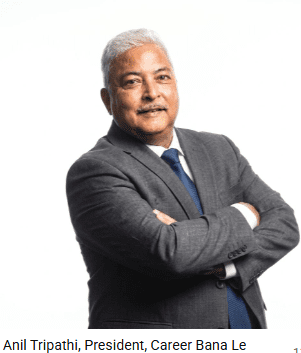
- Mr. Anil Tripathi, President, Career Bana Le
93% of Indian students between 14 and 21 are aware of fewer than 10 career options. There are over 300 viable paths available to them. That gap is not a talent problem. It is a guidance problem.
India produces more graduates every year than almost any country on earth. It also produces one of the world’s most unequal distributions of opportunity within a single education system.
The student in South Mumbai and the student in a small town in Uttar Pradesh may sit the same board exam. They may score similar marks. But what happens after that exam is shaped by something unrelated to ability. It is shaped by who they know, what they have been told is possible, and whether anyone with relevant knowledge ever sat across a table from them and explained their options.
That is the opportunity gap. In 2026, localised guidance is beginning to close it.
The gap is not about access to schools. It is about access to information.
India’s gross enrolment ratio at the secondary level now sits at approximately 77%. Schools exist. There are students present. Although not entirely resolved, the infrastructure issue has been improved over the past 20 years.
The quality of counseling that is offered both inside and outside of those schools has not improved at the same rate.
In Tier 2 and Tier 3 municipalities, fewer than 10% of schools have career counselors with training. Most rely on spontaneous advice from family members or instructors. Students often have no access to professionals beyond their local economy, usually limited to teaching, government jobs, or family businesses.
The repercussions are quantifiable and precise. It’s highly likely that a student in a smaller city who aspires to work in supply chain analytics, climate policy, or UX design has never met a professional in any of those professions. The career does not exist in their immediate world. So they do not choose it. Not because they could not do it. Because no one told them it was an option.
This knowledge gap leads to poor career decisions, reduced confidence, and eventually, unemployability. It is not a soft problem. It produces hard economic outcomes for individuals and for the country.
What localised guidance actually means
It does not mean replicating what exists in metros and shipping it to smaller cities.
That approach has been tried. It does not work. A counsellor trained entirely on urban, English-medium assumptions cannot effectively advise a first-generation learner from a Marathi-medium school in Aurangabad whose family has never engaged with a corporate employer.
Localised guidance means something more specific. Guidance delivered in the student’s language. Advisors who understand the financial constraints of families in that region. Career pathways that account for what is achievable from that starting point, not just what is theoretically possible in the abstract.
Platforms now available in Bengali, Gujarati, Kannada, Marathi, and Tamil are beginning to address this. The regional language component is not a minor detail. It is the difference between a student who understands the guidance they receive and one who nods along and walks out unchanged.
The first-generation learner problem
First-generation students are the ones who are most neglected by the present guidance system. pupils whose parents did not go to college. Students who do not have a professional network at home. Every post-school decision is unfamiliar to these students.
First-generation and rural students require organized support networks. Access to corporate positions and further education is frequently determined by one’s level of English proficiency. Rather than a lack of aptitude, these kids are at a disadvantage because of their lack of exposure.
This is where localised guidance carries the most weight.It is not necessary to advise a first-generation student to have greater aspirations. They require someone to walk them through the precise steps from their current location to their desired destination. The dream has already materialized. What’s lacking is the map.
Why 2026 is a turning point
Two things have converged to make localised guidance more scalable than ever before.
The first is digital infrastructure. A student in a remote town can now access psychometric tests, one-on-one video counseling, and recorded chats with professionals in the field thanks to inexpensive smartphones and broad internet connection. Three years ago, content was physically unreachable; today, it is technically accessible.
The second is institutional recognition. Major education organisations are now opening counselling centres in Tier 2 cities including Nagpur, Jaipur, and Indore. This is not charity. It is a market response to demonstrated demand. Families in smaller cities are willing to invest in guidance when it is available, credible, and relevant to their context.
What still needs to happen
Digital access solves the reach problem. It does not solve the trust problem.
A student in a Tier 3 city receiving guidance from a platform headquartered in Bengaluru is still receiving guidance from outside their world. The most effective interventions are where local counsellors, trained to professional standards, operate within the communities they serve. They know the schools. They know the family dynamics. They know which local employers are hiring.
The opportunity gap in Indian education is real and well-documented. What is newer is the recognition that the solution does not have to come from the top down. It can be built from the ground up. By counsellors who live in the same cities as their students. By platforms that speak the same languages.
The map was always the missing piece. Localised guidance is beginning to draw it.
 admin
admin